
Security Camera Installation in Tulsa
Placement Matters as Much as the Camera
Security camera installation in Tulsa is mostly about where the cameras go. A good camera in the wrong spot records the top of a head, a glare off the parking lot at night, or a doorway from so far away that nobody can be identified. Tulsa Surveillance Technologies installs dome, turret, bullet, and PTZ cameras designed around your property’s layout and its specific weak points, and we draw the placement before we mount anything.
We work on homes, businesses, and large properties across the Tulsa metro, we are licensed in Oklahoma (AC440731), and the system you get is the one on the camera map: numbered positions, coverage cones, notes on height and cable path, and a quote tied to each line. If you already own cameras, we test them on the walk and keep what works.
Before Anything Gets Mounted
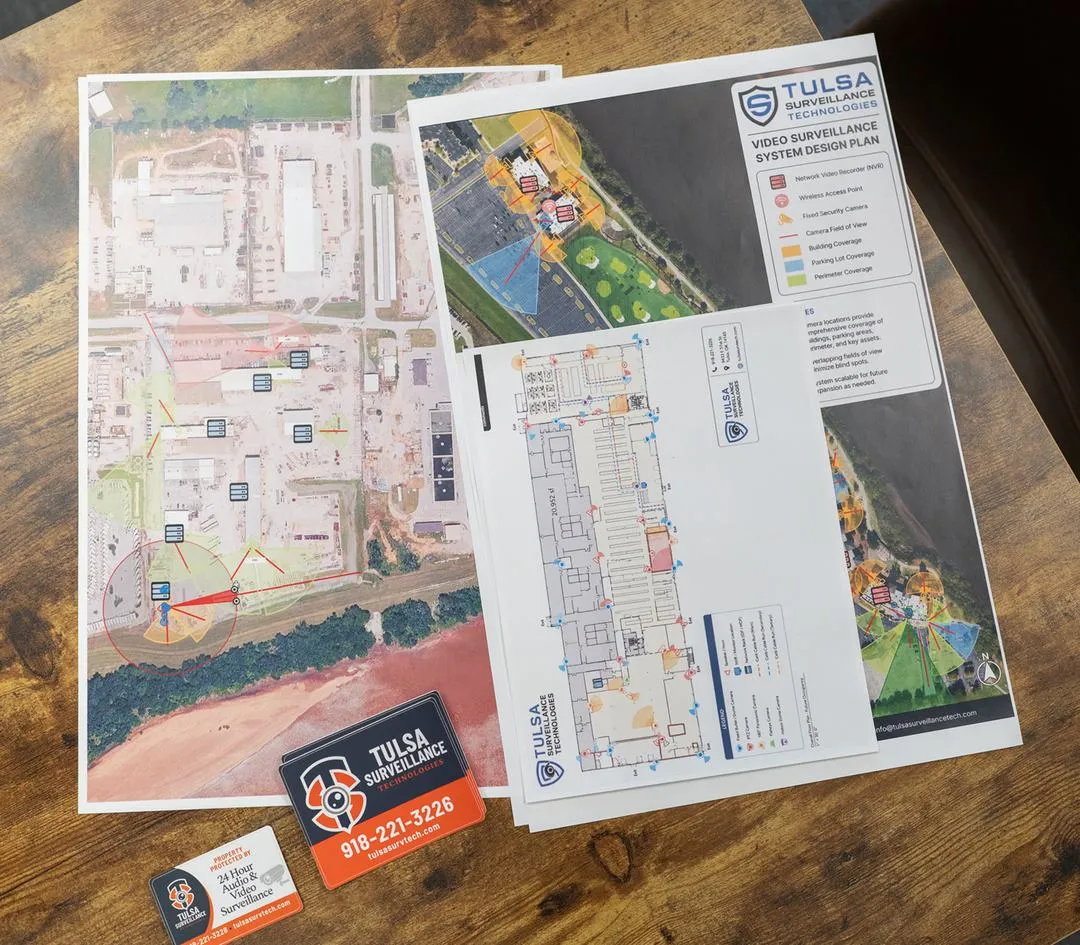
The Camera Map Is the Quote
Every proposal comes with a drawing of your property showing where each camera goes, what it covers, and what it will not. Blind spots show up on paper, not after the install, and you do not pay for angles you did not need.
- Numbered positions tied to the quote
- Coverage cones for every camera
- Lighting, mounting height, and cable path noted
- Yours to keep either way
What We Install
Most new systems are IP cameras recording over power over ethernet to a network video recorder on site, with remote viewing on a phone or a desktop. We install Axis Communications, Hanwha, Digital Watchdog, Uniview, and Hikvision cameras, and we run them on video management software we support: Digital Watchdog Spectrum, Axis Camera Station and Companion, Hanwha Wisenet WAVE, Milestone XProtect, Avigilon Control Center, and Blue Iris. Cloud recording through Eagle Eye is an option where an owner wants nothing on site to maintain.
The housing is chosen per position. A dome goes where tamper resistance matters, such as a lobby ceiling or a stairwell. A turret is easiest to aim and avoids the infrared glare a dome bubble can throw at night, which makes it the default for most exterior walls. A bullet is the visible deterrent that reaches down a drive, a fence line, or a loading dock. A PTZ covers a yard or a lot that a fixed camera cannot, and license plate cameras handle the gate. The camera types page and the hardware and software page go through the equipment in more detail.
Installation Done Properly
The visible part of an installation is the ladder work. The part that decides whether the system is still working in five years is underneath it. Cable is run through attic, wall, or conduit and secured at every point, never left draped where it can be snagged, chewed, or baked on a hot roof. Exterior penetrations are sealed. Cameras are mounted at the height the map specifies, aimed with the live view open, and focused for the distance that matters, which for a face at a door is usually closer than people think.
The recorder is configured for your retention target, motion zones are set so a tree in the wind does not fill the drive, and the network is checked so remote viewing does not depend on a port someone forgot to open. Then the system is tested with you: mobile access on your phone, a clip pulled and exported, and the map updated if anything moved on the day.
Homes
Front door, driveway, back yard, and side approaches, usually four to eight cameras plus a video doorbell, installed in a few hours. The home security page covers the details.
Businesses and Large Properties
Entrances, registers, docks, yards, hallways, and parking, sized to the building and the number of people moving through it. Churches, schools, warehouses, apartments, and retail each have a page under industries.
Already Have Cameras?
Then the first job is a test, not a quote. On the walk we check every camera, every cable run, and the recorder, and most of the time a dark system traces to one of those rather than to the cameras themselves. Where the hardware is sound we quote the repair and keep the cameras. Where it is analog and cannot do what you need, we say so and show you on the map what a replacement would add. The cameras not working page explains the usual causes, and the takeover page covers systems another company installed.
Questions
Camera Installation Questions
How many cameras does my property need?
Fewer than most people expect once they are placed well, and more than the kit on a store shelf. The walk settles it: every entrance, every approach, and every area you need to prove something about gets a numbered position on the map, and nothing else does.
Do you install wired or wireless cameras?
Wired wherever a cable can be pulled, because a camera on power over ethernet never runs out of battery or drops off the wifi. Wireless and solar cameras are used where there is genuinely no path for a cable, such as a gate or a job site.
Can I watch the cameras on my phone?
Yes. Every system we install includes mobile access, and the technician sets it up and tests it on your phone before leaving.
How much footage will I keep?
Retention is sized to your goal and written on the quote in days. Thirty days is a common target for a home or small business; schools, landlords, and insurers sometimes require more.
Client Testimonials
What Clients Say About Working With Us
★★★★★
Let’s Walk Your Property
Free site walk, a camera map you keep either way, and a straight answer about what actually needs replacing.